

Traffic Rider
skgames
Traffic Rider is the kind of motorbike racing game I open when I want immediate action rather than a long setup. Its central appeal is simple: I ride into traffic, judge gaps at speed, and try to keep the run alive while the road becomes harder to read. That focus gives the game a clear identity. It is not trying to be a full motorcycle simulator or a broad collection of racing disciplines. It is built around the pressure of moving through a busy roadway without losing control.
That single idea has carried the game from its release on January 11, 2016, to a very large audience. Traffic Rider is free to install, is suitable for Everyone, and runs on Android 7.0 or later. The developer is skgames, and the game has passed 500 million installs with a 4.5 average from around 8.8 million ratings. Those figures suggest strong staying power, but they do not replace the more important question: does the traffic-riding loop feel good after the first few attempts? In my experience, it does, especially when I treat it as a short-session reflex game rather than a serious racing replacement.
Why Traffic Rider’s traffic challenge works
The most important capability here is not simply riding a motorcycle. It is reading moving traffic quickly enough to make a safe line through it. Cars become obstacles, speed changes the amount of time available to react, and every decision is made while the road continues to pull me forward. That makes ordinary-looking moments surprisingly tense. A clear lane can disappear in an instant, and a gap that seems comfortable at a moderate pace may be useless when I am traveling faster.
Related News

Geometry Dash Lite: Enhanced Rhythms with Android and iOS Updates

How to Make Fortnite Feel Smarter on Mobile

Race Master 3D: The Ultimate Mobile Racing Challenge
I like this design because it turns observation into the main skill. In many racing games, the best route is marked by a racing line, a series of corners, or a familiar track that can be memorized. Traffic Rider asks for a different kind of attention. I watch the spaces between vehicles, check what is approaching beyond the first obstacle, and decide whether passing now is worth the risk. The road is less about learning one perfect lap and more about managing a constantly changing stream.
The motorcycle perspective also makes the challenge feel personal. I am not looking at a distant car from above; I am close to the road and the traffic around me. That viewpoint makes small steering corrections matter. It also means that mistakes can feel abrupt. A tiny movement at the wrong moment may put the bike directly into a vehicle, so calm hands are more useful than frantic ones.
Related News

Why WhatsApp Messenger Still Makes Everyday Communication Feel Easy

Jurassic World: The Game Is the Better Dino Tycoon for Strategic Players

Threads in Real Life: Who Should Join, Lurk, or Leave

How SHEIN Turned Shopping Into an Endless Content Feed

Should You Switch to Microsoft Outlook on Mobile?

Why Gallery Keeps Pulling Users Back
This is where the game’s “next-generation” promise has practical meaning for me, even without treating it like a console racer. The experience is designed to make a familiar road feel active. The satisfaction comes from threading through traffic cleanly, not from collecting a complicated set of racing rules. When I finish a difficult stretch without contact, I remember the sequence of decisions rather than just the final result.
Learning the road instead of chasing speed immediately
New players may assume that going faster is always the best way to improve. I found the opposite during my first sessions. Speed creates opportunities, but it also reduces the time available to understand what is ahead. A useful early habit is to spend a few runs learning how quickly the bike responds before trying to pass every vehicle. That makes later attempts feel deliberate instead of accidental.
I also recommend looking beyond the nearest car. The first vehicle may have a gap beside it, but another vehicle can close that gap immediately afterward. Planning one obstacle ahead is enough to improve consistency without making the game feel slow. This is a small technique, but it changes the experience from random swerving into a readable sequence of choices.
Gallery
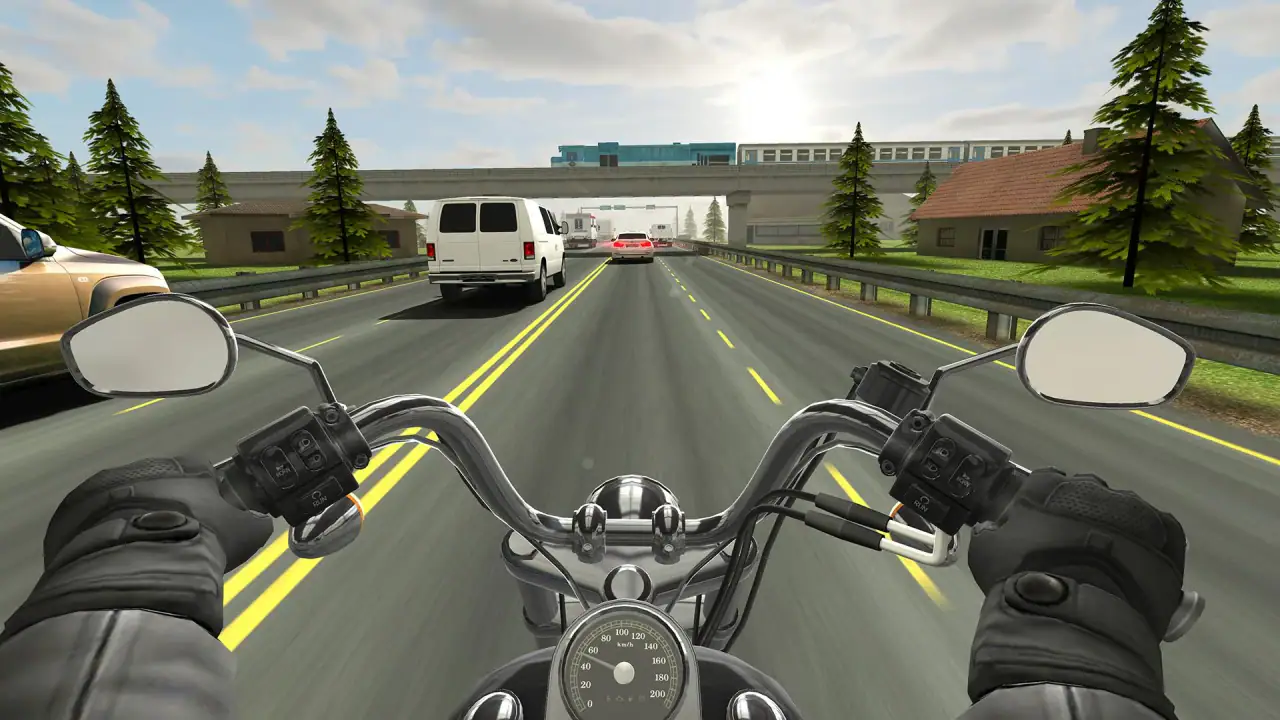
Another practical tip is to avoid treating the center of the road as automatically safest. The best line depends on what the surrounding vehicles are doing. Sometimes a modest correction creates a clean path; sometimes staying steady is better than chasing a narrow opening. The game rewards restraint more often than a player might expect.
What a normal session feels like
I can imagine using Traffic Rider during a short break when I want something interactive but do not want to commit to a long race. A typical session starts with a quick attempt, followed by a second run because I know exactly where the previous mistake happened. That restart-friendly rhythm is one of its strongest qualities. The game does not need a quiet evening or a large block of time to become enjoyable.
For example, if I have a few minutes before leaving home, I can play one run while waiting. I begin cautiously, find a rhythm between the cars, and then take a more ambitious pass when the road opens. If I crash, the failure is easy to understand: I misjudged a gap, moved too late, or allowed speed to outrun my view. That clarity makes another attempt feel worthwhile instead of frustrating for no reason.
The same quality helps when I want a game that works as a mental reset. It demands enough attention to pull me away from a dull moment, but its basic objective is easy to understand. I do not need to remember a story, manage a large inventory, or study a complicated control scheme before playing. I simply need to read the road and ride.
Controls and the value of controlled movement
The controls are most enjoyable when I make small, confident inputs. Overcorrecting is the main enemy. A player who moves constantly from side to side can create danger even when the traffic pattern is manageable. I get better results by deciding on a line, holding it briefly, and changing direction only when the next opening justifies it.
This also explains why the game can feel more demanding than its simple premise suggests. The basic action is accessible, but consistency requires attention. I have to separate a genuine opportunity from a tempting one. A gap that looks open from a distance may close before I reach it, while a slower, wider route may keep the run alive. That trade-off gives the game more depth than a basic “avoid everything” challenge.
Players who prefer precise planning may enjoy this style, but anyone looking for relaxed cruising should know what they are getting. Traffic Rider keeps asking for decisions. Even when the road looks familiar, the timing of those decisions changes. It is a game about maintaining focus, not merely holding a button and watching scenery pass.
Where the game is strongest—and where it asks for patience
The best fit for short, repeatable attempts
The game is at its best when I use it in short bursts and accept that improvement will come through repetition. Each failed run gives me a specific lesson: I entered a gap too quickly, waited too long to move, or focused on one vehicle instead of the whole line. That feedback loop is more valuable than a long tutorial because it comes directly from my own decisions.
It is also a good choice for players who enjoy score-chasing without needing a traditional circuit. A normal track racer often asks me to learn corners and braking points. Here, the challenge is more fluid. I am chasing a better run through traffic, and the satisfaction comes from staying composed when several choices appear at once.
That makes it suitable for casual players who want a free racing game with an immediate premise, as well as experienced mobile players who enjoy reflex challenges. The Everyone rating also makes it approachable for a broad audience. Still, approachable does not mean effortless. Younger or less experienced players may need time to understand that careful movement is more effective than constant speed.
The trade-off between free access and paid pressure
Traffic Rider is free, which makes trying it easy, but in-app purchases range from $1.99 to $99.99 per item. That matters when deciding how to approach progression and spending. I would begin without buying anything and first decide whether the traffic loop itself holds my attention. If the core riding feels repetitive to me, spending will not solve that problem.
My advice is to treat purchases as optional convenience rather than part of the reason to start. The game’s strongest moments come from better judgment on the road, not from owning something simply because it is available. Players who dislike any form of in-app purchase should be especially cautious about whether the surrounding progression fits their preferences.
This is also where Traffic Rider differs from a premium racing game. A paid game with no purchase prompts may offer a cleaner, more predictable experience, while a free game is easier to install and test immediately. I prefer the latter here because the central mechanic reveals its value quickly, but the choice depends on how strongly a player wants an uninterrupted progression path.
Why it is not a replacement for every racing game
I would not recommend Traffic Rider to someone whose main goal is competitive circuit racing, deep vehicle tuning, or realistic motorcycle simulation. Its appeal is concentrated on riding through traffic. If I want structured laps, head-to-head competition, or a garage built around detailed customization, I would look at a different kind of racing game.
It is also not ideal for someone who dislikes repetition after a mistake. The game expects me to try again, adjust my timing, and gradually become more reliable. That can be satisfying, but it can also feel narrow if I need constant variety. The focused design is a strength for quick sessions and a limitation for players who want several distinct activities in one package.
Visual speed can create another point of friction. Fast movement makes the road exciting, but it can also make mistakes feel sudden, particularly when I am tired or playing without full concentration. I get the best results when I use it as an attentive activity rather than something to play while multitasking.
Three techniques that make a real difference
- Read two layers of traffic: I look at the nearest vehicle and the space beyond it before committing to a pass. This reduces the number of times I enter a gap that is about to disappear.
- Use restraint as a skill: I do not force every opening. Waiting for a wider route often produces a longer run than taking a risky shortcut for a momentary gain.
- Review the mistake, not just the crash: After an impact, I identify the decision that caused it. Was my approach too fast, was my movement late, or did I ignore the next vehicle? This turns repetition into practice.
Those habits are useful because they address the actual source of difficulty. They do not depend on memorizing a track or relying on luck. They improve how I process the road, which is the capability that gives Traffic Rider its personality.
Who gains the most from the focused design
I think the best audience is someone who enjoys immediate mobile racing, likes improving through repeated attempts, and wants a motorcycle game that can be played in small sessions. It suits people who find satisfaction in clean movement and quick decisions. It is particularly appealing if the idea of passing traffic feels more interesting than simply following a fixed racing line.
It can also work for players who are new to racing games because the objective is easy to understand. The game does not require knowledge of racing terminology before the first attempt. At the same time, experienced players can find depth in timing, positioning, and risk management. That combination is one reason the game has remained relevant long after its January 2016 release.
I would suggest skipping it if you need a story-driven experience, a social competition focus, or a highly detailed simulation. I would also skip it if repeated near-misses and crashes quickly make you angry. The game’s satisfaction depends on accepting that failure is part of learning the road. Without that patience, its focused loop may feel more restrictive than entertaining.
Device expectations and starting advice
Because the minimum requirement is Android 7.0, many Android users can at least consider trying it without needing a recent operating system. I would still close unnecessary background activity before a serious session if my device is older, simply because fast visual movement benefits from steady performance. That is practical preparation rather than a promise that every phone will feel identical.
My starting routine would be simple. I would play several cautious runs, avoid spending money immediately, and focus on keeping a smooth line through traffic. Once I could consistently identify the next opening, I would begin taking calculated risks. This approach makes the game’s learning curve feel fair and helps reveal whether its central challenge is genuinely enjoyable for me.
Traffic Rider has earned its place as a well-known free racing game because it does one thing clearly: it turns motorcycle riding through traffic into a test of timing and attention. I appreciate that focus. It gives short sessions a purpose, makes improvement easy to feel, and creates memorable moments from ordinary road situations.
My final recommendation is positive, with a clear condition: try it for the riding challenge, not for features it was never designed to provide. The free entry point and Everyone rating make it easy to explore, while the 4.5 average and more than 500 million installs show that the format has connected with a broad audience. Just remember that in-app purchases can reach $99.99 per item, and that the best progress comes from learning when to move and when to wait.
If you enjoy quick motorcycle runs where one well-judged gap can save an entire attempt, Traffic Rider is worth installing. I would recommend it to a friend who wants a focused, repeatable road challenge. I would not present it as a complete racing simulator, but as a sharp mobile game built around reading traffic, it remains easy to pick up and surprisingly difficult to master.
FAQs for Traffic Rider
What is Traffic Rider and what makes it unique?
Traffic Rider is a first-person motorcycle racing game that delivers an immersive and realistic experience. Unlike typical racing games, it features a career mode with over 70 missions and 30 motorbikes to unlock. The game offers real-life recorded bike sounds and detailed environments, making it stand out in the mobile gaming world.
Is Traffic Rider available for both Android and iOS devices?
Yes, Traffic Rider is available for download on both Android and iOS platforms. You can find it on the Google Play Store for Android devices and the App Store for iOS devices. The game is free to download, with optional in-app purchases available to enhance your gaming experience.
What are the system requirements for Traffic Rider?
Traffic Rider requires Android version 5.0 or higher and iOS version 9.0 or later. It’s compatible with most smartphones and tablets, but for the best experience, a device with a decent GPU and at least 1GB of RAM is recommended. This ensures smooth gameplay and optimal graphic performance.
Does Traffic Rider require an internet connection to play?
Traffic Rider can be played offline, making it perfect for gaming on the go. However, an internet connection is required to access certain features, such as leaderboards and achievements. Additionally, connecting online allows you to back up your progress and compete with friends.
Are there any in-app purchases in Traffic Rider?
Yes, Traffic Rider offers in-app purchases. Players can purchase in-game currency to unlock new bikes and upgrades faster. While these purchases can enhance gameplay, they are entirely optional. The game is designed to be fully enjoyable without spending money, as all content can be unlocked through gameplay.
Pros
- Immersive first-person view enhances realism.
- Wide variety of bikes to unlock and upgrade.
- Smooth graphics and detailed environments.
- Simple controls make it easy to play.
- Regular updates with new features and content.
Cons
- Repetitive gameplay may become monotonous.
- In-app purchases can be expensive.
- High storage requirements on devices.
- Limited customization options for bikes.
- Can be challenging for casual gamers.


